There is currently a raging debate about data centers. There is misinformation on both sides. Yes, data centers have been around for fifty years. Yes, they are critically important to our infrastructure. However, using these facts to dismiss the sentiment against the current build-out is disingenuous. Let’s explore why, and then discuss where the real AI bottleneck exists.
The most common objection to data centers is the water usage. Some are claiming that they use too much water, and some are claiming they use very little to none. Both sides are wrong, and both sides are right. As usual, the problem is more complex than either side portrays.
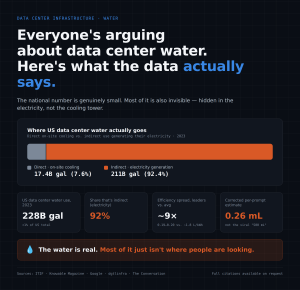
Let’s start with total current consumption. US data centers currently consume roughly 17.4 billion gallons of water directly for cooling and another 211 billion gallons indirectly used at power plants to generate the electricity those data centers draw. This sounds like a lot, but it is under 1% of total annual US water consumption (you all be some thirsty souls out there). For every one gallon of water a data center uses, twelve gallons get used upstream for power. Keep that in mind as we continue. The people defending data water usage are correct on this point; they currently use very little water. But there is much more to this than the current usage.
One quick side note: the bottle-per-email claim that AI uses turned out to be spectacularly incorrect. A medium Gemini text turns out to be the equivalent of five drops of water. A really bad assumption caused this error.
But the AI water usage problem still has real issues. The type of technology used and geographical locations have real negative consequences. Closed-loop and air-cooled designs push data center consumption to near zero. Google’s air-cooled data center in Pflugerville, TX, uses only about 10,000 gallons of water a year. But not all data centers have this design. Google’s Council Bluffs data center uses roughly a billion gallons of water in 2024. Same company, two different data centers with completely different results.
And location matters, not just in real estate, but in data center water consumption. In some areas, billions of gallons of water consumed annually can be a drop in the bucket. But in drought-affected regions like Arizona, New Mexico, and Southern California, data centers could strain already limited water sources, affecting your local environment.
While the current water usage is not an issue, if data centers scale at the desired rate, the impact will be felt by 2030, and not just in water-strained regions. Data centers will go from 1% water utilization to 3%-9%. Worse, no one is quite sure exactly how much water usage will be needed. Disclosure is voluntary and inconsistent. This needs to change, as Data Centers consume two of the most precious commodities of modern civilization: water and power.
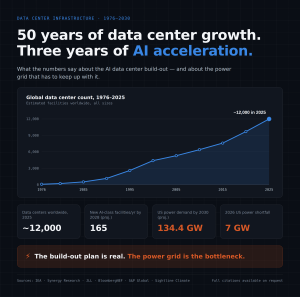
AI data centers have much higher power consumption and generate way more heat. Combine this with the scale, and you’ll have issues. Global data center power capacity grew from 21.4 GW (2005) to an estimated 114.3 GW (2025). US data center demand is real and rising fast. 61.8 GW in 2025, up 22% year-over-year, and projected to hit 134.4GW by 2030. However, power companies have only committed to roughly 12-16 GW of capacity for 2026, and only about 5 GW is actively under construction.
We simply do not have enough power in the US or elsewhere to handle this much growth. Whether you believe that there will be this much AI demand to warrant this build-out (personally, I don’t) is immaterial. We are a decade away from providing this much power to data centers, even if we could find enough approved sites to build them.
Combine rising water demands and the lack of power for planned data centers, plus the lack of any perceived profitability path, no technology moats, and no sign that AI is going to replace jobs wholesale. These over-$1 trillion currently promised investments appear to have no potential for return; there is no other way to describe this but as a market bubble.
Yet AI (Complex Information Processors) has great potential and has produced great results. All research for this article was performed by AI, saving me hours of work. Grammarly keeps me from looking like the student who struggled with grammar and spelling. The tool is powerful, but it cannot exist in the current paradigm. Then what is the future?
Private AI. Small LLMs and other flavors of AI solving very specific problems with specific data sets. Private AI is the future. And we will discuss this next time we meet.