When you look at the numbers you can actually find on the AI Data center buildout, you will see what I see: only a small percentage of what was promised has actually been built. And there are signs that the future reality of this buildout is facing headwinds that will significantly slow its growth.
Why is this important? Its significance is twofold. First, if token demand reaches the hyper-optimistic scenarios prescribed by OpenAI and Anthropic by 2030, there will be problems because there will not be enough data centers to support it. If AI is in a bubble (as this author believes), it may help limit the damage to the market and the economy as a whole if it does pop. A third, more disconcerting explanation exists. We will explore all three of these scenarios in Part II of the AI Bubble.
The raging debate over AI data center buildout centers on power and water, which we covered last week (link to last week’s article). This raises the question: how many data centers are actually being built? One side says there are too many; the other says there aren’t enough to meet growth and demand. As we discussed last week, both sides are right, and both sides are wrong.
As we break down the numbers below, let’s address a few caveats. First, no one has an official number on AI data center buildouts. To arrive at the numbers we will be discussing, Claude and I took aggregates across the board from multiple sources, noting the numbers they agreed on, particularly when they disagreed in other areas. Also, many data sets do not distinguish between AI and other types of data centers. We will also highlight discrepancies we found in the reported data.
The Funnel
As of August 7th, 2026, Aterio reports 3,976 data centers not started, 809 under construction, and 2,056 operational. That’s 4.9 announcements for every project on the ground. About one in five breaks ground. CNN reported the same numbers two days earlier, and Bloomberg NEF independently counted 831 under construction in June1. The consensus is that of all the announced data centers, only one in five reaches the bulldozer stage.
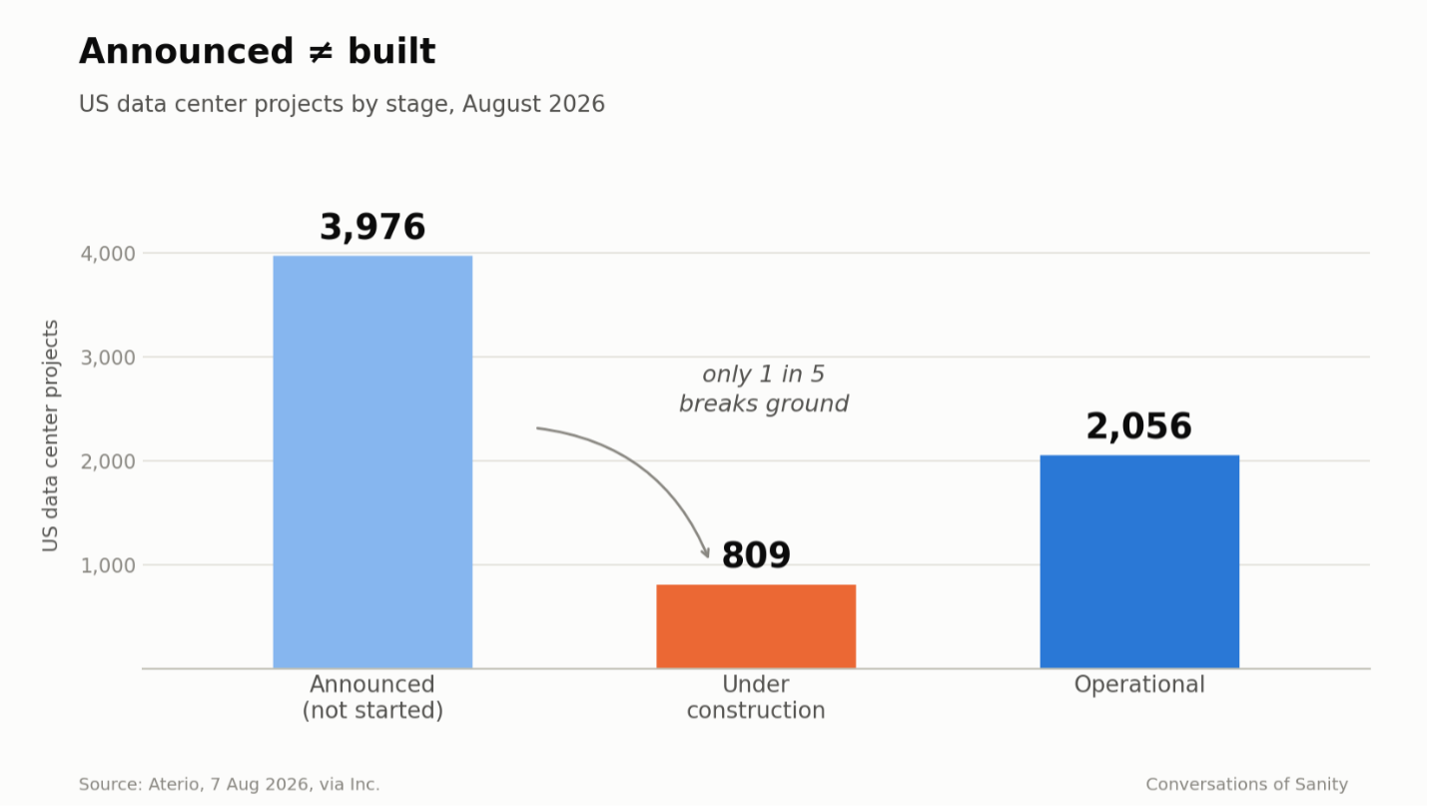
The temptation is to look at these numbers and think the hoopla over the AI data center buildout is much ado about nothing. This is a mistake. As shown below, AI data center growth is significant. It currently accounts for 24% of the housing market and now exceeds traditional office construction in the United States2,3. This buildout is unlike anything seen since WWII.
Another problem is that nobody can agree on what a data center is. Here are seven current trackers, all within the last four months, all counting “US data centers.”
| Tracker | Total Facilities Tracked | Date | What it actually counts |
| Epoch AI, Frontier Data Centers Hub | 86 (global) | 10 Sept 20264 | Frontier AI training sites,100 MW+, operational 2024 or later |
| AI Data Center Index | 346 (global), 84 US | 18 June 20265 | AI-designated facilities, 64 countries |
| Compute Atlas | 1,563 (US) | 10 Sept 2026Beginning: 6 | US grid-scale compute sites, 5,054 cited sources |
| MMCG Invest census | 1,784 (US, deduplicated) | 12 June 20267 | Address-deduplicated US properties |
| Aterio | 6,800 (US, all stages) | 7 Aug 20268 | Announced + under construction + operational |
| dcmap.us | 4,998 (US) | Aug 20269 | All data centers incl. telecom and legacy colo |
| Stanford HAI AI Index 2026 | 5,427 (US) | Apr 202610 | “AI data centers,” >10× any other country |
As you can see, it’s all over the place. As Mark Twain infamously quoted, “There are lies, damned lies, and statistics.” Data is important. When used properly, it can help you ask the right questions. It can also be used to obfuscate.
Counterarguments need to be discussed. SemiAnalysis published a rebuttal in June 2026 titled, “Stop Saying Half of 2026 US Datacenter Capacity is Canceled.” They argue that cancellation clusters are almost entirely in early-stage announcements that were never in any serious forecast to begin with. Their numbers show that projects canceled after ordering equipment and signing interconnection agreements are less than 1% of North American hyperscaler self-build capacity and under 5% of North American colocation11. They argue that looking at the data any other way is uninformative; the projects that matter the most are getting built.
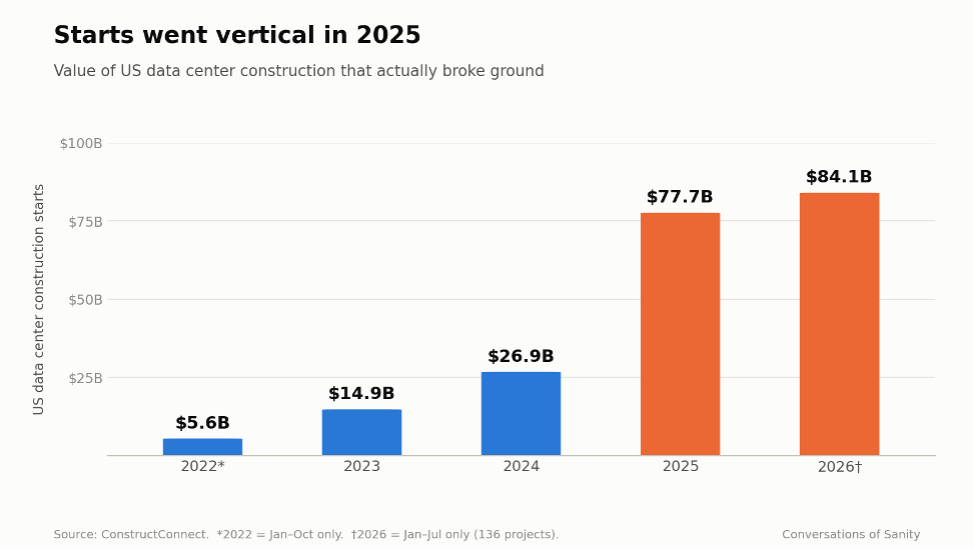
This is a valid point. Both facts can be true: the announcement bubble is enormous, and the projects that matter the most are mostly getting built. But additional headwinds are coming into play, and evidence shows the data center announcement bubble is bigger than originally thought.
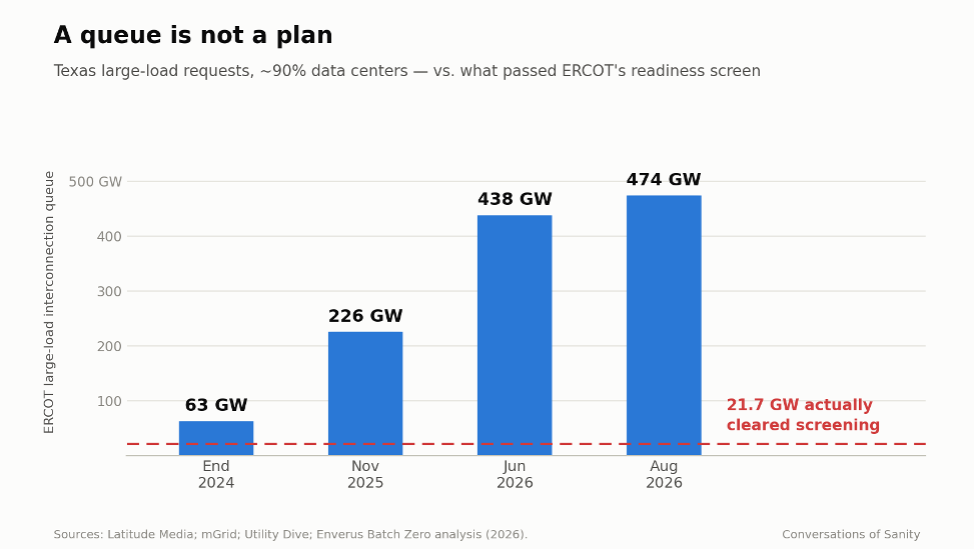
This evidence comes from two states, Texas and Ohio. In August of this year, Texas Governor Abbott ordered an audit of proposed data centers in Texas12. Why? Because the total wattage usage, if all were built, would be 474 GW, more than five times Texas’s record peak demand. After the audit, ERCOT’s “Batch Zero” screening process found that only 55 projects totaling 21.7 GW were expected to clear13. Only 5% were expected to pass, and fewer than 10% have refiled under the new requirements. However, this is a forecast.
In Ohio, we have the cleanest proof of queue inflation, where a utility measured it. AEP Ohio imposed a data center tariff that required customers to pay for at least 85% of requested power, whether they used it or not. While some drop-off was expected, it wasn’t anticipated to drop from 30+ GW to 13 GW, a drop of more than half14. The utility explained that “the most speculative or uncertain data center projects” were eliminated. Speculation hit reality when they attached an actual price to the request. The original model didn’t forecast this.
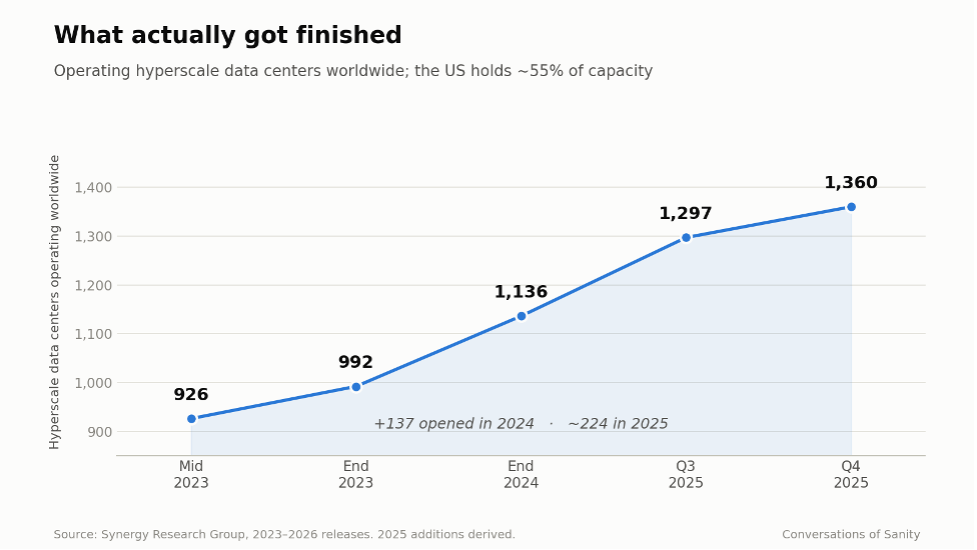
By this point, you are probably as confused about the data as I was when I first examined it. So let’s touch grass for a moment and look at what is actually operational through 2025. As you can see, the announced number is growing much faster than the actual number being built in 2025, and while there is no hard data yet for 2026, the gap appears to be widening.
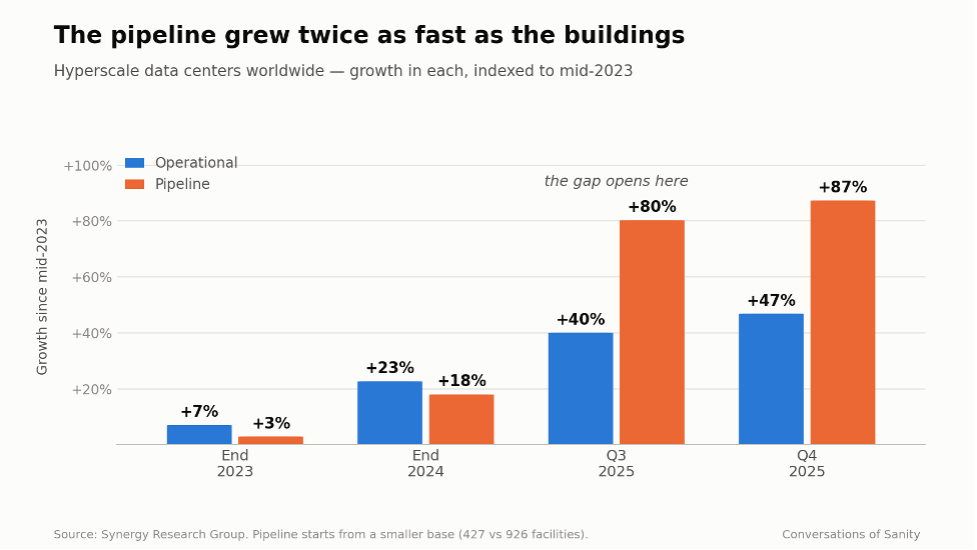
Additional evidence points to trouble in AI Paradise. Microsoft reportedly canceled around 200 MW of data center leases and up to 2 GW of US and European projects15. Google and Meta absorbed some of the European leases, and Microsoft maintains it is still on track for $80 billion in additional data center spending. Other news agencies and investment firms report continual slippage between announced, planned, and construction-started figures, as seen below.
- Goldman Sachs: historically 72% of scheduled data center capacity comes online on time. For AI data centers 2026–2028, they forecast roughly 50%.
- JPMorgan: 60% of capacity planned for 2027 completion has not begun construction; 7% is already formally delayed.
- SynMax (satellite imagery, 4 Aug 2026): 20 GW of projects slated for 2027 completion had not begun land clearing. SynMax cut its 2027 completion estimate from ~37 GW to “low 20s GW.”16
- Currence (Feb 2026): Of 16 GW slated for 2026 across ~140 projects, only ~5 GW was under construction; ~11 GW had no visible progress. They project 30–50% of that pipeline will not come online within the year. Looking backward: “In 2025, 26% of expected capacity slipped, and another 10% of projects pushed back their commercial operation dates without much notice.”
Other tangible obstacles to the AI data center buildout exist beyond power and water, as discussed previously. The numbers clearly show an AI Data Center announcement bubble. Does it matter? Yes, it does. We will put this together to show the real challenges the AI rollout faces beyond the well-discussed profitability and moat challenges in Part II of the AI Bubble in our Conversations of Sanity.
[2] ConstructConnect, “September 2026 Data Center Report,” 28 Aug 2026. https://news.constructconnect.com/september-2026-data-center-report-year-to-date-spending-nearly-three-times-a-year-ago
[3] CoStar, “Data Center Spending Hits Record Levels in 2026,” 3 Aug 2026. https://www.costar.com/article/1713855862/data-center-spending-hits-record-levels-in-2026
[4] Epoch AI, Frontier Data Centers Hub, updated 10–11 Sept 2026. https://epoch.ai/data/ai-data-centers · Methodology: https://epoch.ai/data/data-centers-documentation/methodology
[5] AI Data Center Index, snapshot 18 June 2026. https://aidatacenterindex.com/ (Subpages returned 404; methodology unverified.)
[6] Compute Atlas, Edition v1.32.0, 10 Sept 2026. https://www.compute-atlas.com/stats
[7] MMCG Invest, “The U.S. Data Center Census 2026,” 12 June 2026. https://www.mmcginvest.com/post/the-u-s-data-center-census-2026
[9] dcmap.us, data as of Aug 2026. https://dcmap.us/
[11] SemiAnalysis, “Stop Saying Half of 2026 US Datacenter Capacity Is Canceled,” 18 June 2026. https://newsletter.semianalysis.com/p/stop-saying-half-of-2026-us-datacenter
[12] Utility Dive, “Texas hits pause on data center interconnections,” 5 Aug 2026. https://www.utilitydive.com/news/texas-hits-pause-data-center-interconnections/827046/
[13] Juan Arteaga, Enverus Intelligence Research, “ERCOT Large Load Batch Zero Readiness,” 16 June 2026 (rev. 11 Aug 2026). https://www.enverus.com/newsroom/ercot-large-load-batch-zero-readiness/
[14] Data Center Dynamics, “AEP Ohio slashes data center pipeline by more than half,” 1 Oct 2025. https://www.datacenterdynamics.com/en/news/aep-ohio-slashes-data-center-pipeline-by-more-than-half-report/
[15] Data Center Dynamics, “Microsoft cancels up to 2GW of data center projects, says TD Cowen,” 27 Mar 2025. https://www.datacenterdynamics.com/en/news/microsoft-cancels-up-to-2gw-of-data-center-projects-says-td-cowen/ · Bloomberg, 24 Feb 2025. https://www.bloomberg.com/news/articles/2025-02-24/microsoft-cancels-leases-for-ai-data-centers-analyst-says